The Cost of Libby on Local Libraries
Disclaimer: I'm a huge fan of Libby, but I wrote this to send to local New York represenatives in the hope they may rethink how much it costs them to use the service. As someone with experience with these types of CDNs, I was hoping to shed some light on it.
The Digital Drain: How E-Book Licensing Is Draining New York's Public Libraries
An Open Letter and Policy Brief regarding the systemic financial extraction of civic resources by digital publishers and intermediaries.
Executive Summary
Public libraries across New York State are facing funding battles. While community conversations frequently center on local municipal budget cuts, a silent fiscal crisis is occurring behind the scenes: the unsustainable cost of digital media.
Platforms like Libby (developed by OverDrive) provide a great user experience, but the underlying business-to-business licensing models imposed by major publishing houses operate on a system of artificial scarcity and price gouging. This document outlines the economic disparities between consumer digital rights and library licensing, demonstrates how taxpayer funds are being extracted by corporate gatekeepers, and proposes structural compromises to establish a fair balance between publishing intellectual property and public literacy.
1. The Core Disillusion: Ownership vs. Permanent Rent-Seeking
In the physical world, public libraries operate under the protection of the First Sale Doctrine (Section 109 of the U.S. Copyright Act). When the New York Public Library (NYPL) or a local system in the Hudson Valley purchases a physical hardcover book, they own that physical object permanently. It can be loaned to readers until the pages wear out, and the institution pays for the item once.
In the digital landscape, publishers have exploited a legal loophole. Because digital files are licensed rather than sold, the First Sale Doctrine does not apply. Libraries are forced into a model of perpetual rent-seeking:
- Metered Access: E-book and digital audiobook licenses do not represent ownership; they expire after a fixed duration (typically 24 months) or a limited number of loans (typically 26 checkouts).
- Massive Price Markups: While a retail consumer can buy an e-book on Amazon for $12.99 to keep forever, a public library is regularly charged $60.00 to $95.00 for a temporary, expiring license of that exact same digital file.
Cost-per-Checkout and Lifespan Contrast
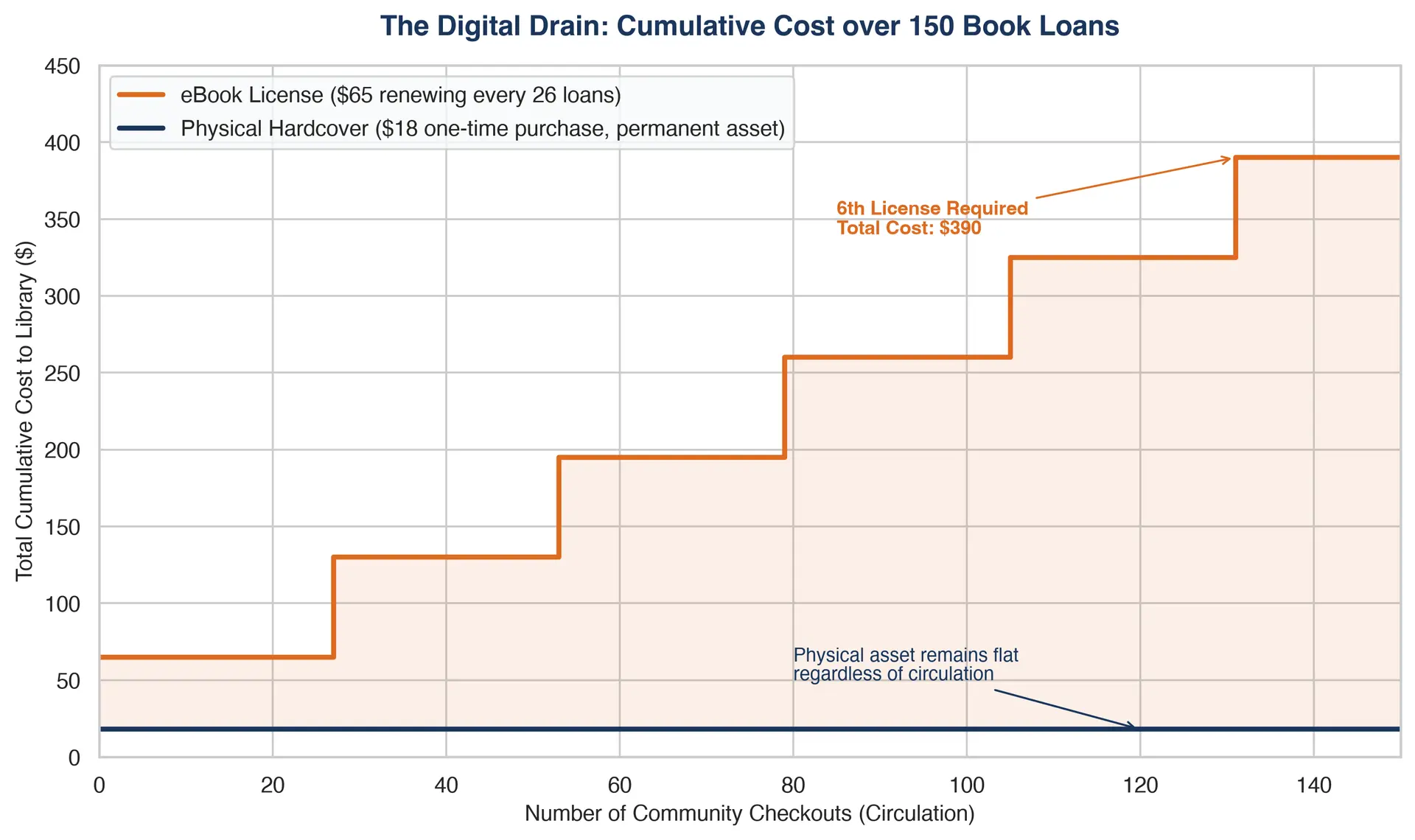 Figure 1: Cumulative financial trajectory of library software licensing overhead compared to a one-time physical asset purchase over 150 community loans
2. The Tech Industry Parallel: CDN Efficiency vs. Corporate Extortion
From a technical infrastructure perspective, digital distribution is incredibly cheap. Audiobooks and e-books are static media assets. When a user streams an audiobook or downloads an e-book via Libby, the data is served via global Content Delivery Networks (CDNs) like AWS CloudFront or Cloudflare. For comparison, these static file serving CDNs are magnitudes less resource hungry than their AI datacenter counterparts.
At enterprise scale, hosting and data egress costs are measured in fractions of a cent per gigabyte:
- An average e-book file is 2 megabytes (MB).
- An average high-quality audiobook file is 300 megabytes (MB).
- Delivering 300MB of data via a modern CDN costs less than $0.02 (two cents) in data transport fees.
When compared to consumer platforms, the extortion of public funds becomes obvious:
- Audible / Amazon Kindle: A retail consumer pays a predictable monthly subscription or a flat one-time cost to buy an audiobook. Once purchased, the consumer can stream or re-download that content indefinitely. Amazon covers the CDN hosting costs seamlessly within the consumer retail price.
- Netflix: While Netflix operates on complex B2B streaming window contracts, they license massive catalogs for simultaneous streaming to millions of concurrent users.
- Apple: Historically, tech giants like Apple have tightly controlled software ecosystems to protect their recurring revenue (similar to their resistance to free, over-the-air AM/FM radio chips in early iPhones to funnel users toward paid cellular data and Apple Music).
Publishers and distribution intermediaries are adopting the worst parts of this tech gatekeeping. They charge libraries prices that resemble premium, multi-user enterprise software suites, while simultaneously restricting access to just one user at a time per license. They are charging manufacturing prices for data that costs virtually nothing to host or deliver.
3. The Misuse of Taxpayer Funds and Regional Inequities
This predatory pricing structure creates a direct drain on New York taxpayer dollars. Property taxes and state funding intended to keep physical library branches open, staff community centers, and expand literacy programs are instead being diverted to pay recurring licensing fees to multinational publishing conglomerates.
This dynamic also worsens regional inequities across New York State. The New York Public Library (NYPL), backed by a massive tax base and a large private endowment, can afford to purchase large portfolios of digital licenses to maintain an extensive catalog (though even their budgets are heavily strained).
Smaller systems, such as those throughout the Hudson Valley Library System, face a brutal fiscal reality. Because their budgets are a fraction of the size of metropolitan systems, they struggle to keep up with expiring licenses. Taxpayers in smaller jurisdictions pay the same state taxes but receive vastly inferior access to digital knowledge, as their local branches are priced out of the market.
Regional Digital Equity Map
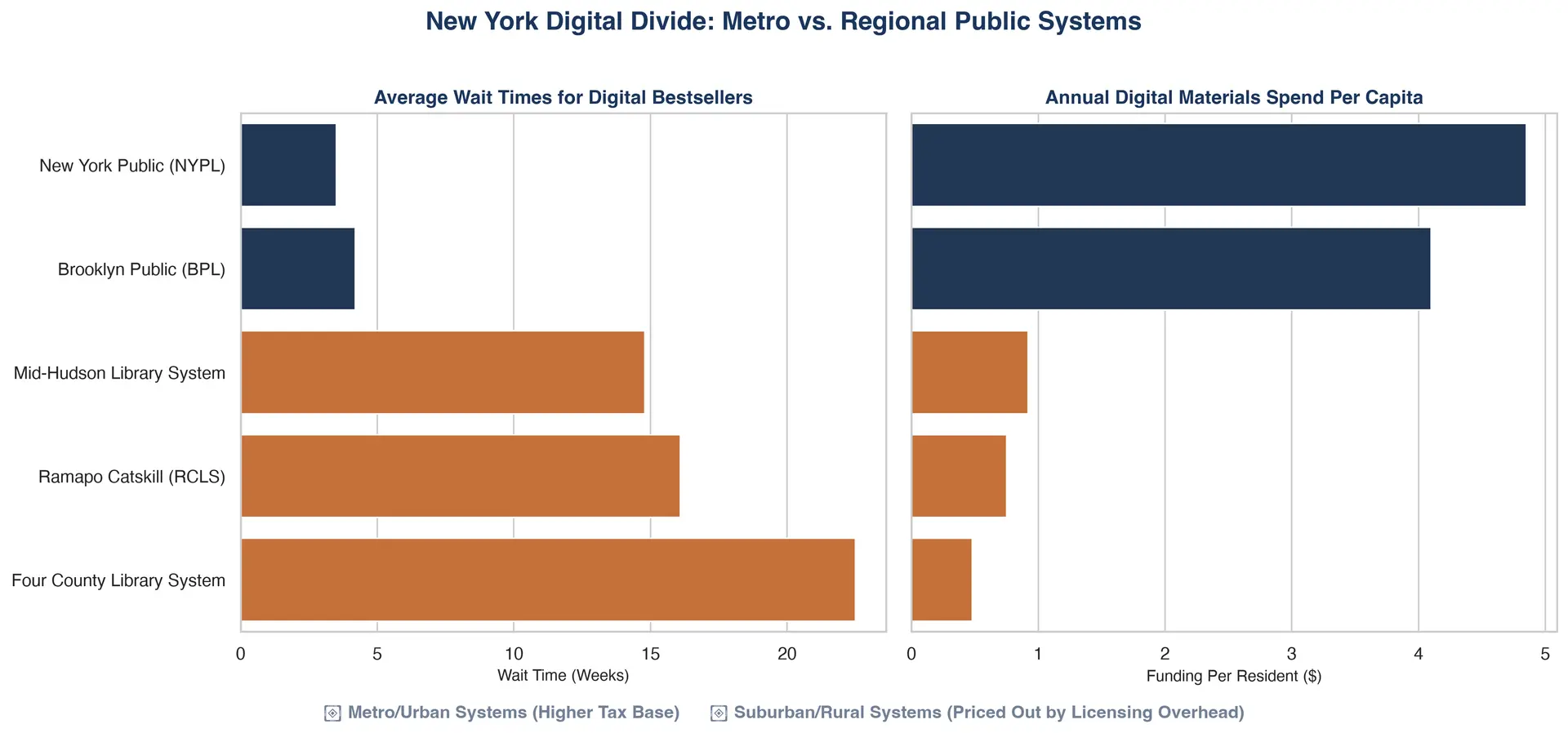 Figure 2: Average wait times for digital bestsellers contrasted against annual digital materials spend per capita across New York public library systems.
4. Framework for Compromise: Simulating Physical Realities
Libraries shouldn’t want to be anti publishing industry or not pay authors. They deserve to be compensated fairly including library usage. However, a sustainable middle ground must be established. We propose two major structural compromises that protect publisher revenue while stopping the financial burden that digital licensing puts on public libraries:
Compromise A: "Digital Shelf Space" (Caps over Expiration)
Instead of forcing digital licenses to expire based on arbitrary timeframes (2 years) or checkout limits (26 loans), publishers should allow libraries to purchase a permanent digital license tied to a simultaneous user cap. This cap can be based on a number of factors such as book age (newer books have tighter caps), library user size, and even genre specific caps (educational books could have higher caps compared to fiction).
For example, if a license cap is set to 3 for a specific title, it functions identically to physical shelf space: if a library buys 3 digital copies, they can lend it to exactly 3 people at a time. If a 4th user requests the book, they join a waitlist. Impatient users who do not wish to wait will naturally drop off and purchase the book directly on retail platforms. This preserves the "artificial friction" publishers require to protect retail sales, but eliminates exploitative expiration rules, allowing libraries to build permanent back-catalogs.
Compromise B: Interlibrary Digital Lending Networks (IDL)
In the physical world, New York libraries utilize highly efficient Interlibrary Loan (ILL) networks. If a reader in a small Hudson Valley town needs an obscure biography that only the NYPL owns, the physical book is shipped to the local branch, read, and returned.
We should digitize this system by legalizing Interlibrary Digital Lending (IDL). If the NYPL has an unutilized digital license allotment for a title during a period of low local demand, the system should allow that digital token to be temporarily transferred to a Hudson Valley system experiencing a high waitlist. Once the loan expires, the digital asset automatically routes back to the home institution. This maximizes the utility of every taxpayer dollar spent on digital media across the entire state.
Conclusion & Call to Action
The current trajectory is unsustainable. As digital media use continues to grow, these e-book licensing fees will consume the budgets of our public library systems.
New York State has a proud history of legislative leadership in consumer protection and public education. Lawmakers must look past the lobbying of the Association of American Publishers (AAP) and implement state-level contract and consumer-protection frameworks that mandate fair, non-expired digital licensing terms for public institutions. Libraries are the foundational pillars of an informed democracy, and they must no longer be treated as a way for publishers to greatly profit.
Research and References
- Association of American Publishers v. Frosh (2022): The landmark federal court case that struck down Maryland's fair library e-book law, affirming that federal copyright law preempts state-level mandates on copyright holders.
- Hachette Book Group, Inc. v. Internet Archive (2023): Federal ruling defining the limits of digital reproduction, holding that scanning physical books for 1-to-1 digital lending constitutes copyright infringement rather than fair use.
- American Library Association (ALA) State Advocacy Reports (2024-2026): Data tracking state-level legislative efforts in Connecticut, Massachusetts, Illinois, and New York to leverage state contract law and consumer protection statutes to bypass federal preemption.
- NYPL Annual Financial and Operations Briefings: Publicly available expenditures detailing the growing percentage of materials budgets allocated exclusively to digital platform maintenance and recurring metered licenses.