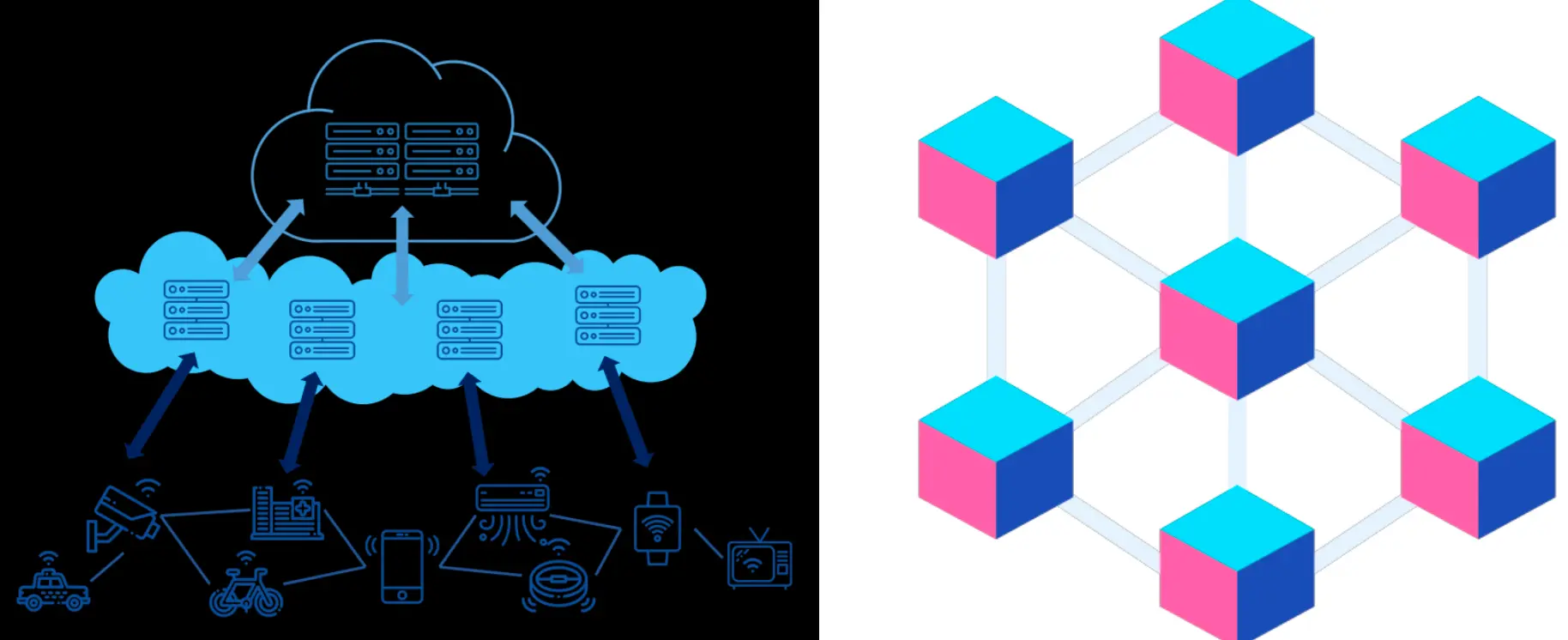
Blockchain and Edge Computing Working Together
Blockchain is celebrated as the decentralized trust machine, while Edge Computing is the speed machine, pulling computation power away from distant clouds and placing it right next to the user.
While the two technologies do different things, they actually compliment each other, where the greatest strength of one technology happens to be the exact cure for the biggest limitation of the other.
Here is a developer-centric breakdown of why blockchain and edge computing are a match made in architectural heaven, the frameworks making it happen, and the engineering hurdles we still have to clear.
The Core Dilemma: Respective Blind Spots
To understand why an integrated approach works, we first have to look at the architectural wall each technology hits when deployed completely on its own:
- The Blockchain Headache: Blockchain platforms provide security, transparency, and decentralization. However, they choke when it comes to scalability. Low transaction throughput and high latency make them impractical for real-time, high-speed applications.
- The Edge Computing Headache: Edge computing solves the cloud's latency issues by bringing processing and storage capacity right to the lip of the network, drastically boosting responsiveness and Quality of Service (QoS). Yet, because its environment is highly distributed and fragmented, it faces severe security and decentralized management vulnerabilities.
The big idea? By integrating them, we can use blockchain to secure the edge, and use the edge to scale the blockchain.
| Technology | Core Strength | Structural Weakness |
|---|---|---|
| Blockchain | Immutable security, trustless consensus, total decentralization. | Bad scalability, low throughput, high latency. |
| Edge Computing | Local proximity, ultra-low latency, high responsiveness. | Weak distributed security, complex resource management. |
Blockchain Mechanics as an Edge Control Layer
To see how blockchain secures a messy network of edge nodes, we have to look at its underlying layers and security primitives.
A standard blockchain is built from the ground up across seven layers: Data, Network, Consensus, Ledger Topology, Incentive, Contract, and Application. When we map this to edge computing, these layers transform into a robust management stack.
The Security Anchors
Transactions are bundled into blocks cryptographically chained via their headers, utilizing a prev_block_hash and a merkle_root to make tamper-detection instantaneous. Individual actions are authorized via digital signatures, using public/private key pairs (Gen, Sign, Verify) to provide unforgeable authorization without ever exposing private credentials.
For an edge network, this means configuration updates, access permissions, and data routing rules can be signed, broadcast, and permanently locked into an immutable ledger.
Choosing the Right Consensus
How distributed nodes agree changes how the integrated system performs:
- Proof-of-Work (PoW): Ultra-secure but massively slow and energy-expensive. Bitcoin's reliance on PoW requires roughly an hour for safe transaction finality, making it useless for immediate edge operations.
- Proof-of-Stake (PoS): Significantly faster and greener, relying on validators who stake economic collateral, risking "slashing" penalties if they attempt malicious behavior.
- PBFT (Practical Byzantine Fault Tolerance): Rapid-fire validation designed for permissioned networks where the validating nodes are already known, making it a prime candidate for enterprise edge deployments.
Solving Each Other’s Problems
When these worlds collide, they form a highly cooperative ecosystem.
Edge computing inherently operates across a three-tiered layout, where End Devices communicate with Edge Servers, which selectively talk back to the Core Cloud. While this architecture preserves local bandwidth and keeps processing delays low, managing thousands of heterogeneous, vulnerable edge nodes is an administrative nightmare.
Blockchain steps in to provide a decentralized trust model, automating resource allocation via programmable smart contracts (similar to those executed on Ethereum’s EVM environment) and ensuring complete data integrity across all nodes.
On the other hand, edge computing cures blockchain's scaling bottlenecks. To increase throughput, modern blockchains use advanced topologies like Sidechains, Off-chain scaling (ex: the Lightning Network), Plasma chains, or Sharding.
The catch? Every single one of these scaling techniques requires abundant computational resources outside the main blockchain chain to compute tasks before settling them on the ledger. Edge computing nodes are perfectly positioned to act as this off-chain engine.
Architectural Patterns in Action
To build a functional blockchain-edge framework, engineers generally deploy one of two architectural patterns:
- Local Private Chains: Edge servers run a localized, permissioned blockchain strictly for nearby IoT or smart home devices, ensuring bulletproof, super fast local control.
- P2P Server Chains: Edge and cloud servers link together globally over a consortium blockchain, enabling secure, large-scale coordination and tamper-proof data sharing across different networks.
To make these frameworks work, the system must maintain strict authentication, dynamic adaptability to fluctuating loads, data integrity, low latency, and verifiable computation.
| 1. SECURE NETWORKING | 2. RELIABLE STORAGE | 3. VERIFIABLE COMPUTATION |
|---|---|---|
| • Software-Defined Networking (SDN): Centralized, programmable network control. • Smart Contracts: Instantly update network flow tables and virtualization rules immutably. • Resilience: Built to be inherently resistant to routing attacks. | • Off-Chain Processing: Bulky data stays off-chain in distributed architectures like IPFS or BigchainDB. • Data Integrity: Blockchain tracks the unique cryptographic file hash and maps data locations via decentralized DNS (Blockstack). | • Resource Offloading: Heavy computational lifting (like mining or AI tasks) is safely offloaded to edge nodes. • Trustless Validation: Systems like TrueBit use on-chain "games" to verify and reward honest computation results. |
The Roadblocks Left to Clear
While the synergy is there, building these integrated systems comes with steep challenges:
- Integration Complexity: Forcing entirely different protocols such as networking hardware, distributed storage arrays, and consensus engines to play nicely together adds massive software overhead.
- Resource Management: Running cryptographic operations and validating ledger states adds a computation tax. Efficiently allocating tasks without draining the limited power of smaller edge nodes remains a major hurdle.
- Self-Organization Risks: Automated, self-managing edge ecosystems run via smart contracts open up highly complex, novel attack surfaces if the underlying code contains subtle vulnerabilities.
What's Next?
To bypass traditional blockchain bottlenecks, researchers are moving away from single-chain structures entirely, experimenting with alternative ledger structures like Directed Acyclic Graphs (DAGs) (ex: IOTA's Tangle) which offer high-throughput validation without blocks.
Furthermore, the future is leaning to an AI-Edge-Blockchain convergence. In this future layout, edge devices run heavy AI analytics locally, blockchain secures and verifies the integrity of the training data and computation models, and machine learning models continuously optimize the blockchain's resource allocation and network topology on the fly.
By forcing these two distinct technologies to fix each other's flaws, we aren't just building faster or safer systems, we are building the foundational framework for a truly decentralized, low-latency, and trustless web.