Catching Bugs Early with Software Fault Prediction
In our software-driven world, code runs almost every facet of modern life. But with scale comes complexity, and with complexity come bugs. It is a well-known engineering reality that the cost of fixing a software defect increases exponentially as it moves down the Software Development Lifecycle (SDLC). Finding a bug during the early design or coding phase is a minor fix, but finding that same defect post-release can cause crashes, security vulnerabilities, and financial losses.
To shift the bug hunt left, researchers and practitioners rely on Software Fault Prediction (SFP). By analyzing a systematic literature review (SLR) covering a decade of research, we can map out exactly how data mining, machine learning, and deep learning techniques are being used to predict system defects before they ever hit production.
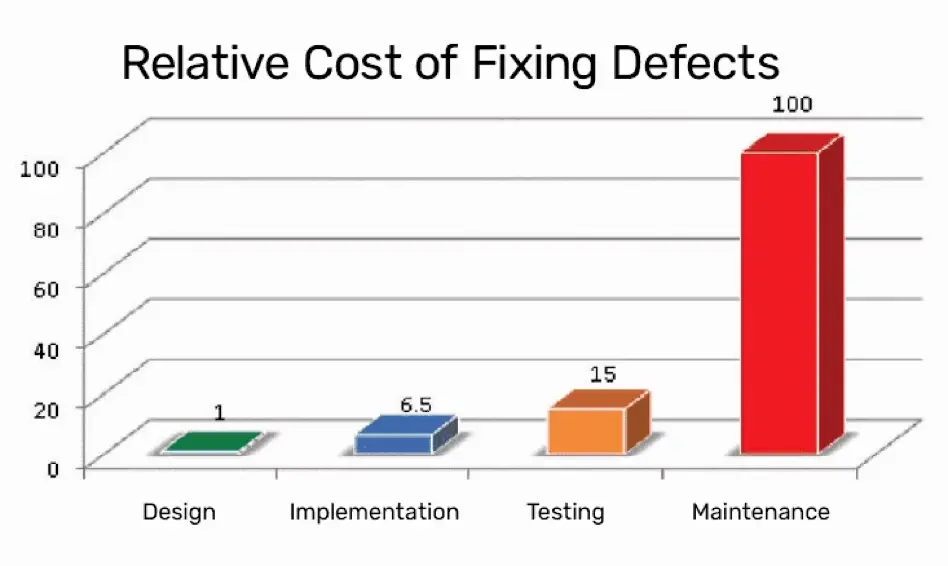 Much cheaper to fix defects early
Navigating the Data: The Selection Process
To map an entire field of computer science accurately, researchers filter out the noise using a strict three-phase methodology: Planning, Conducting, and Reporting.
The initial database search across major repositories, which includes IEEE Xplore, ScienceDirect, SpringerLink, Wiley, and Google Scholar, yielded a massive pool of over 1,700 articles. By applying strict inclusion and exclusion criteria alongside rigid quality assessments, this mountain of papers was funneled down to 68 primary studies. These papers form the empirical backbone of modern software fault prediction trends.
The Decade-Long Technical Shift (2010–2021)
An analysis of the primary literature reveals an evolution in software engineering philosophy over the last decade:
- The Data Mining Era (Early 2010s): Traditional, highly interpretative data mining tools like Decision Trees and Naive Bayes were the default choices. They offered quick, lightweight statistical overviews of code health.
- The Machine Learning Pivot (Mid-2010s onward): As software systems grew more convoluted, developers shifted toward advanced Machine Learning models (especially ensemble methods and Support Vector Machines) to map complex, non-linear code patterns.
- The Deep Learning Wave (Recent Years): The industry has seen an explosion of interest in deep learning architectures (like CNNs and LSTMs). These models handle huge, raw code representations directly, showing promise in predictive accuracy.
The Testing Grounds: Datasets and Metrics
To train these predictive engines, researchers rely heavily on public, open-source repositories like the NASA and PROMISE datasets. These baselines evaluate code health across three software metric categories:
- CK Metrics: Evaluate object-oriented design characteristics like inheritance depth, coupling, and cohesion.
- McCabe Metrics: Measure cyclomatic complexity, charting the number of linear execution paths through the source code.
- Halstead Metrics: Analyze the algorithmic complexity by measuring program volume, vocabulary, and overall mental development effort.
The SFP Toolbelt: Comparing Core Techniques
Every predictive paradigm brings its own unique trade-offs to a development pipeline. The table below breaks down the strengths and weaknesses of the primary techniques uncovered in the review:
| Paradigm | Core Technique | Strengths | Weaknesses |
|---|---|---|---|
| Data Mining (DM) | Decision Trees (DT) Naive Bayes (NB) | Simple to visualize, computationally lightweight, highly interpretable. | Prone to overfitting; often assumes unrealistic feature independence. |
| Machine Learning (ML) | Ensemble Methods (Random Forest, Boosting) | Combines multiple models for exceptional robustness and accuracy. | Can become difficult to interpret compared to single-tree models. |
| Machine Learning (ML) | Support Vector Machines (SVM) | Highly effective in high-dimensional spaces with non-linear relationships. | Highly sensitive to hyperparameter tuning and kernel selection. |
| Deep Learning (DL) | Convolutional Neural Networks (CNN) | Exceptional at processing structural code representations and text patterns. | Demands massive training datasets and high computational overhead. |
| Deep Learning (DL) | Long Short-Term Memory (LSTM) | Explicitly specialized for sequential data (like tracking code evolution over time). | Complex to architect, time-consuming to train, and operates as a "black box." |
Real-World Architectural Bottlenecks
While the academic results are promising, especially with deep learning and ensemble models consistently leading the pack in predictive accuracy (AUC and F1-scores), implementing SFP in production engineering pipelines hits three persistent roadblocks:
- The Class Imbalance Problem: In any well-engineered codebase, the vast majority of modules are non-faulty. Because healthy code heavily outnumbers buggy code, predictive models easily become biased toward the majority class, completely missing the rare, critical faults they were built to catch.
- The Industrial Data Gap: The overwhelming majority of SFP research relies on clean, public, historic academic datasets. These models often struggle when dropped into massive, messy, fast-moving enterprise environments.
- Lack of Standardization: Different research pipelines utilize completely localized evaluation metrics and validation techniques, making a direct, apples-to-apples performance comparison difficult.
The Next Frontier in Bug Hunting
To bypass these operational speed bumps, the next wave of software fault prediction is actively moving toward sophisticated deployment patterns:
- Graph Neural Networks (GNNs): Moving past flat text analysis to treat source code as an Abstract Syntax Tree (AST) or a complex control-flow graph, letting deep learning models understand actual program logic.
- Transfer Learning: Training giant, comprehensive baseline models on massive open-source code repositories, then safely transferring that pre-trained code intelligence to predict defects in small, proprietary enterprise systems.
- Hybrid Engineering Frameworks: Marrying automated machine learning classifications directly with hard-won human expert knowledge to filter out false positives and catch silent, catastrophic edge cases.
Software fault prediction is transforming from a reactive testing approach into a defensive, automated shield. By integrating these predictive techniques directly into continuous integration (CI/CD) pipelines, engineering teams can identify code structural flaws in real-time. Hopefully this will make higher software quality, cleaner codebases, and lower operational overhead even easier.